
Iron is a metal produced from the mining and refining of ferrous ore. There is debate over the precise definition of wrought iron as opposed to other iron alloys, given its vague name.
“Wrought iron” taken most literally simply means iron that has been worked. “Worked” here indicates forging, as opposed to the less labour-intensive casting production method. Forging is when a metal is shaped through a combination of heat and percussion. This tempers the metal and makes it much more resilient, which is why metal tools are made almost exclusively from forged metal.
Casting metal is fully melting the metal and pouring it into a mold. Since this metal has not been tempered, it tends to be quite brittle. While this does not at first glance seem to imply that the actual materials used in cast iron versus wrought iron are different, the truth is that the iron used in cast iron could not have been forged, or “wrought”. This is because cast iron is mostly composed of “pig iron”, which is less pure. Its carbon content is more elevated than the iron used for wrought, which makes pig iron brittle. Thus, the very fact that wrought iron can be wrought necessarily implies that it is composed differently from cast iron. The composition of wrought iron is naturally low in carbon. This means the metal is more resilient, and thus easier both to weld and forge.
However, the point at which cast and wrought iron actually become different substances is when iron silicate is added to the mix. Iron silicate is a glassy slag that stretches in filaments through the iron, making it more flexible, more corrosion resistant, and more textured, which means that it will hold a thicker finish than smoother metals will.
In his article on the properties of wrought iron, Daniel Todd compares the consistency of this true wrought iron to taffy or bread dough. Wrought iron seems like the ideal material for old-fashioned smithing and metal sculpture. However, while it is true that wrought iron was the material of choice for blacksmiths of old, today it has become a luxury material due to the current relative mass affordability of steel, though steel is much less resilient and ductile, with a very high carbon content.
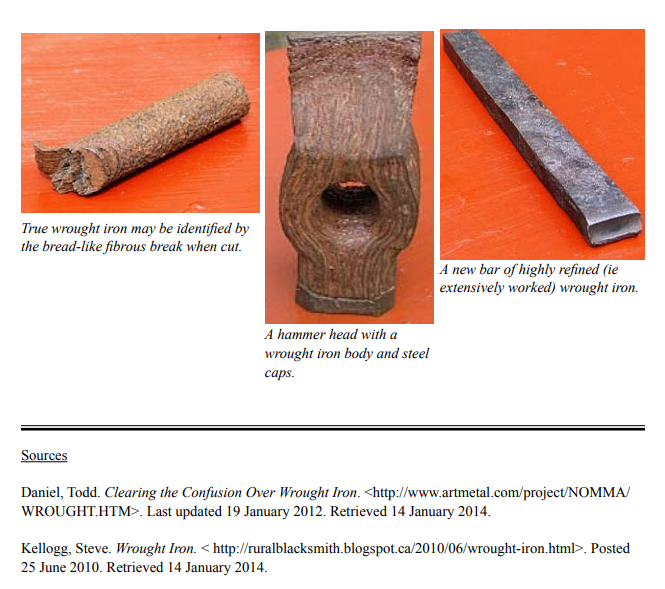
Wrought iron production has in fact entirely been phased out of North America, and if one wishes to procure some, short of finding and smelting an antique wagon wheel, for example, one must import it from Europe. I could not find any in local stores or in the various pieces of antique furniture my family owns, and so I could not photograph or touch any wrought iron myself. I have included above pictures from Steve Kellogg’s blacksmithing blog, in a post wherein he explains how to identify true wrought iron.
“Wrought iron” taken most literally simply means iron that has been worked. “Worked” here indicates forging, as opposed to the less labour-intensive casting production method. Forging is when a metal is shaped through a combination of heat and percussion. This tempers the metal and makes it much more resilient, which is why metal tools are made almost exclusively from forged metal.
Casting metal is fully melting the metal and pouring it into a mold. Since this metal has not been tempered, it tends to be quite brittle. While this does not at first glance seem to imply that the actual materials used in cast iron versus wrought iron are different, the truth is that the iron used in cast iron could not have been forged, or “wrought”. This is because cast iron is mostly composed of “pig iron”, which is less pure. Its carbon content is more elevated than the iron used for wrought, which makes pig iron brittle. Thus, the very fact that wrought iron can be wrought necessarily implies that it is composed differently from cast iron. The composition of wrought iron is naturally low in carbon. This means the metal is more resilient, and thus easier both to weld and forge.
However, the point at which cast and wrought iron actually become different substances is when iron silicate is added to the mix. Iron silicate is a glassy slag that stretches in filaments through the iron, making it more flexible, more corrosion resistant, and more textured, which means that it will hold a thicker finish than smoother metals will.
In his article on the properties of wrought iron, Daniel Todd compares the consistency of this true wrought iron to taffy or bread dough. Wrought iron seems like the ideal material for old-fashioned smithing and metal sculpture. However, while it is true that wrought iron was the material of choice for blacksmiths of old, today it has become a luxury material due to the current relative mass affordability of steel, though steel is much less resilient and ductile, with a very high carbon content.
Wrought iron production has in fact entirely been phased out of North America, and if one wishes to procure some, short of finding and smelting an antique wagon wheel, for example, one must import it from Europe. I could not find any in local stores or in the various pieces of antique furniture my family owns, and so I could not photograph or touch any wrought iron myself. I have included above pictures from Steve Kellogg’s blacksmithing blog, in a post wherein he explains how to identify true wrought iron.